Tabatiere,
Attributed to
Christian
Friedrich Herold, 18th Century
Rare Enamel
Tobacco Box
C.
F. Herold, early Meissen Painter
The purpose of this page is two fold:
1. To publicize this beautiful little box
2. To solve a couple of puzzles about it's origin
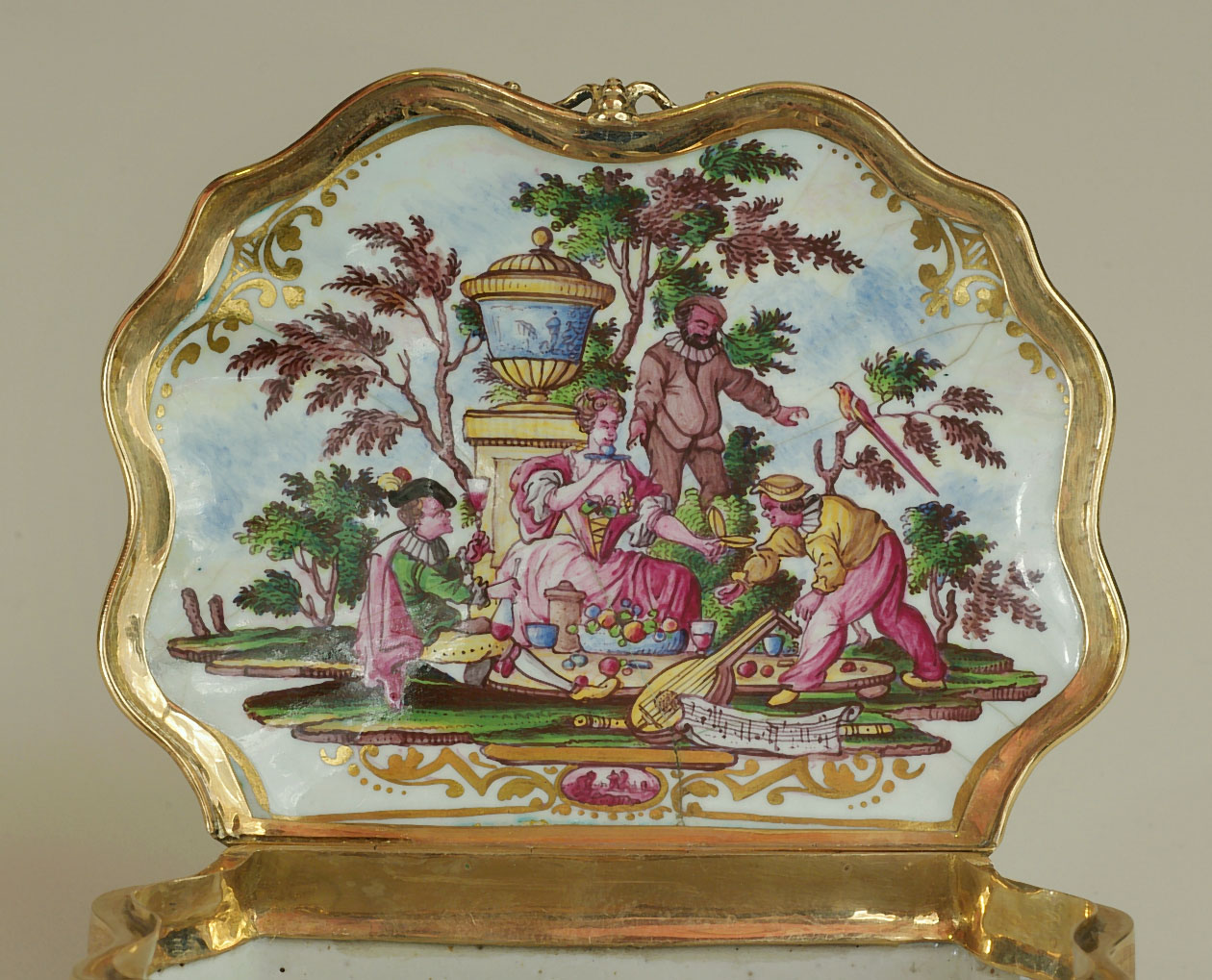
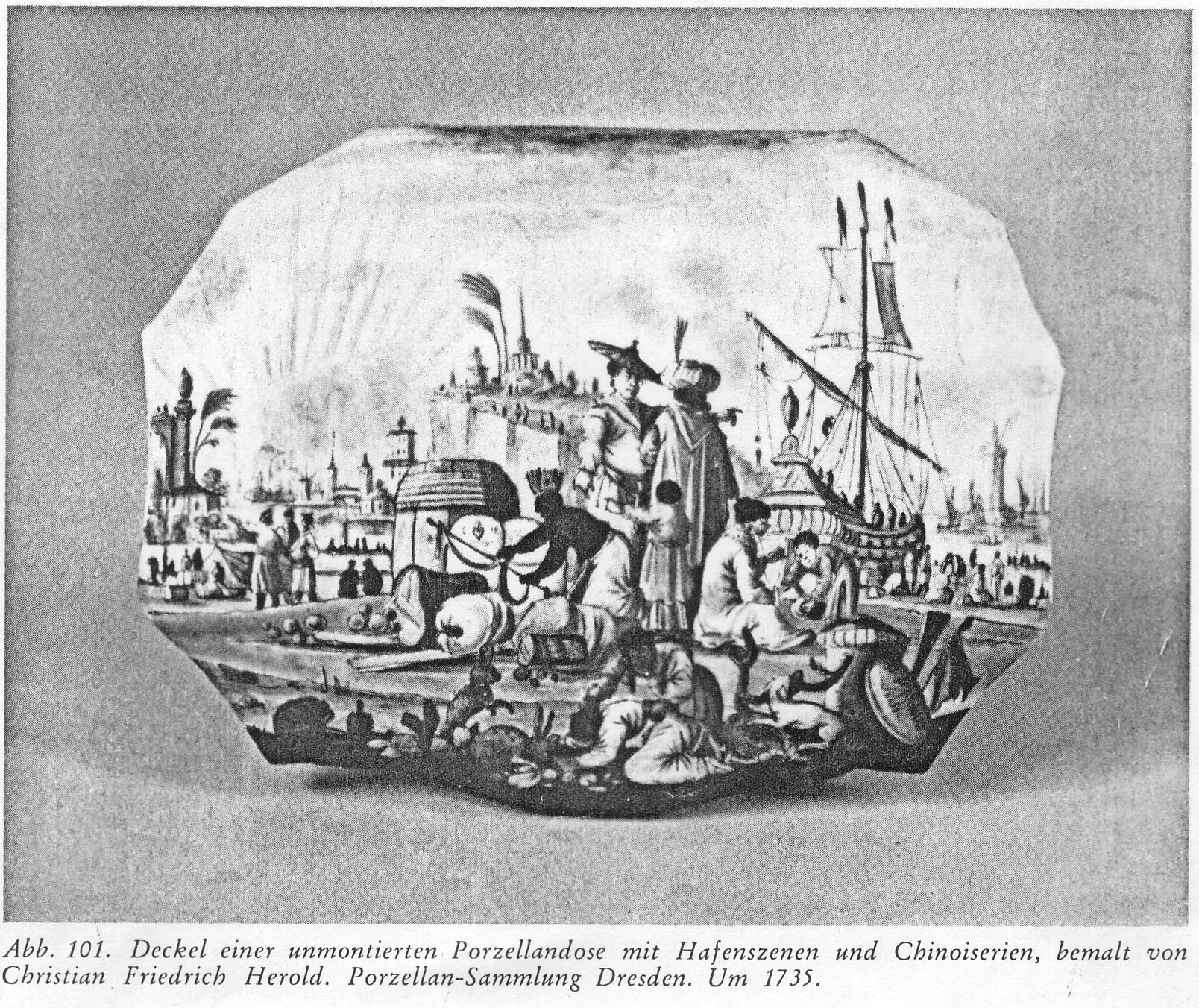
The box is obviously painted in the style of Christian Friedrich
Herold, painter at the Meissen factory, starting in the first quarter
of the 18th century. After working at the Fromery box facility, it is
believed that he started working for Meissen in 1724, and continued
painting copper based boxes there in his spare time. According to
Walter Spiegel, in his book Meissner Porzellan
this was allowed for a time, but as he became more important as an
artist, this divided attention was frowned upon. So, the question is-
When was this box painted? Other examples exist with very similar
subjects. As a matter of fact, the inside cover of this box is
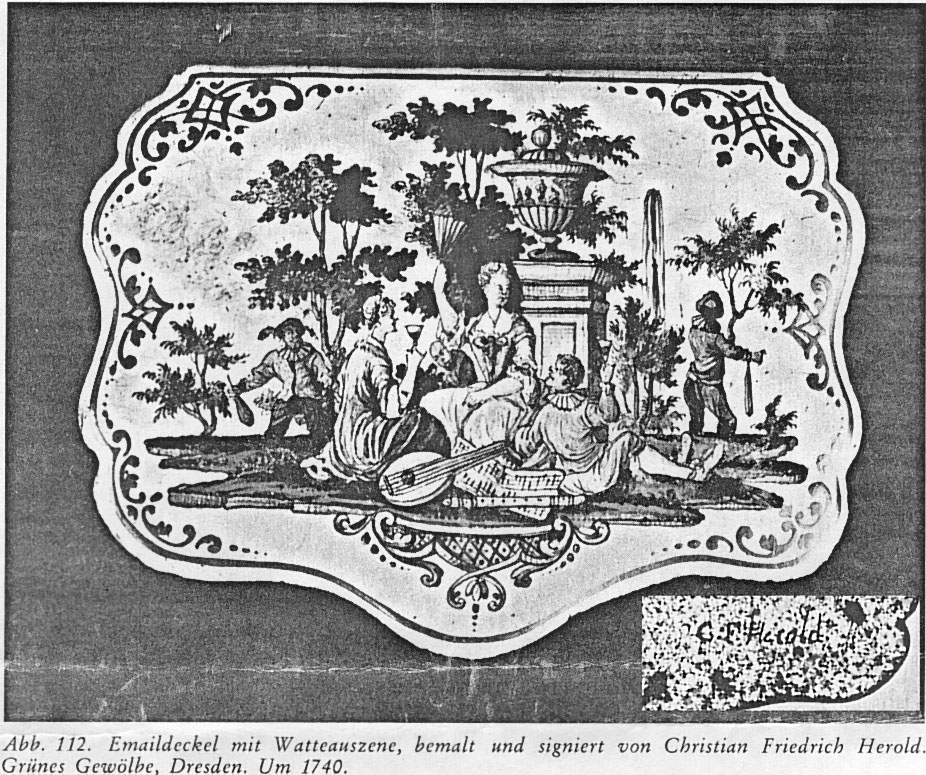
strikingly similar to the outside cover of a box depicted in an article
by Ingelore Menshausen-Handt entitled, Christian Friedrich
Herold.
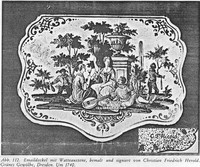 That box was
signed "C.F.H" on the reverse.
|
|
|
So, the origins of our
pretty little "Tabatiere" -as they are referred to in Europe-, is a bit
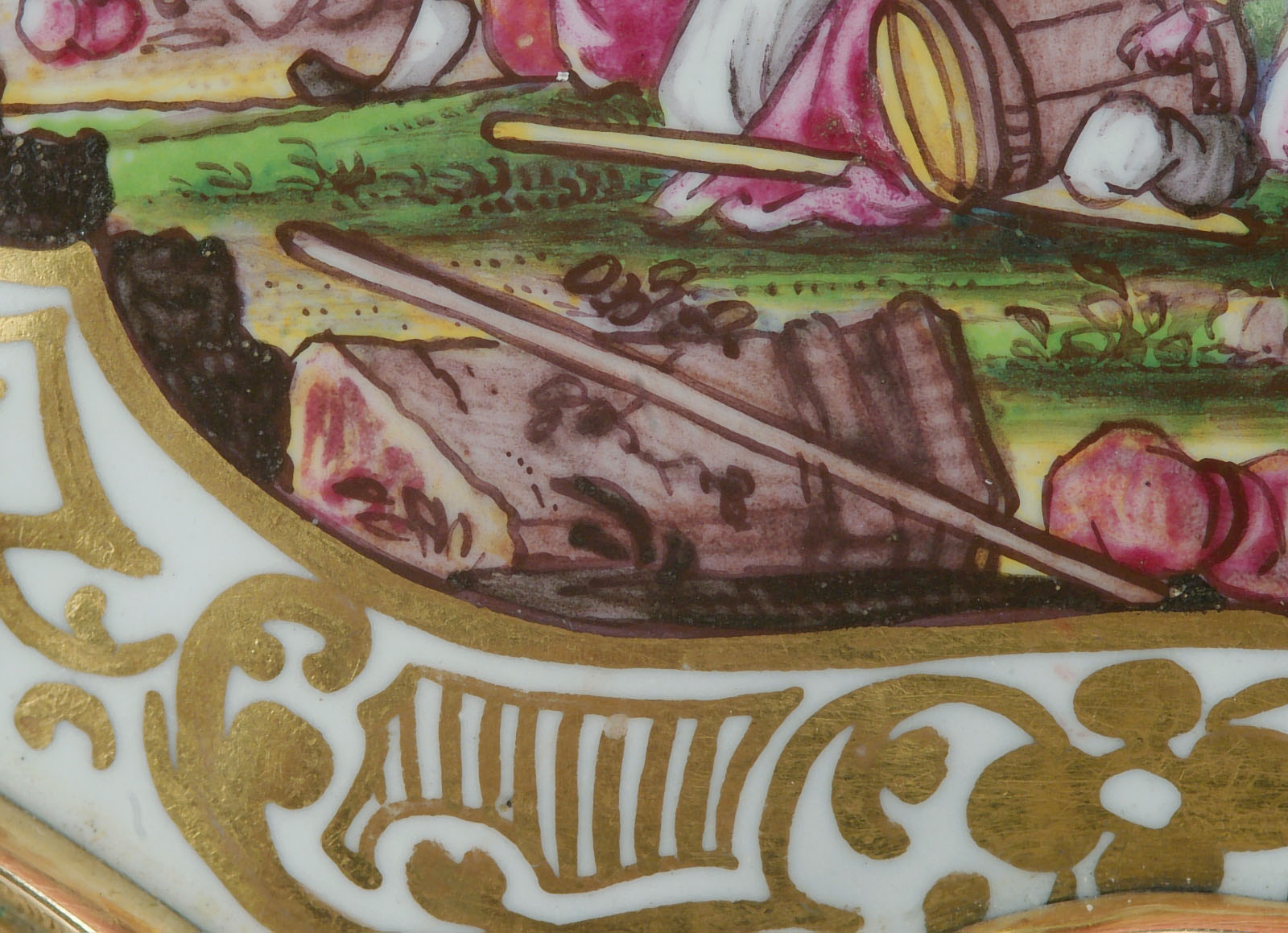
of a mystery. If you look closely at the top panel, you will find, in
the lower left corner, a series of scribbled brushstrokes which
resemble some kind of signature. 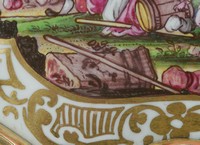 To this day, I have not been able to
uncover the meaning of this cryptic writing, despite an attempt at
mirror imaging, upside down viewing, or a combination thereof. During
the first half of the 18th century, it appearsd there were several
landscape painters working at Meissen, any of which might have tried
their hand at painting these boxes either at the factory or at home,
after hours. Once again according to Spiegel, there were several
painters of landscapes employed at the Saxon factory during that
period: J. G. Heinze, N. E. Bezold, J. B. Wenzel, J. G. Erbsmehl, J. C.
Dietrich, and B.G. Haeuer. But my mind cannot make the signature fit
any of those names either. Perhaps someone viewing this page will have
a moment of inspiration and figure out whose signature is encrypted in
those brushstrokes. To this day, I have not been able to
uncover the meaning of this cryptic writing, despite an attempt at
mirror imaging, upside down viewing, or a combination thereof. During
the first half of the 18th century, it appearsd there were several
landscape painters working at Meissen, any of which might have tried
their hand at painting these boxes either at the factory or at home,
after hours. Once again according to Spiegel, there were several
painters of landscapes employed at the Saxon factory during that
period: J. G. Heinze, N. E. Bezold, J. B. Wenzel, J. G. Erbsmehl, J. C.
Dietrich, and B.G. Haeuer. But my mind cannot make the signature fit
any of those names either. Perhaps someone viewing this page will have
a moment of inspiration and figure out whose signature is encrypted in
those brushstrokes.
Another mystery is the gold framework. The tocacco boxes of the time
usually had gilded copper frame and hinge. This box appears to have a
solid 14 carat frame., beautifully detailed, but probably not of the
same period. Perhaps the original was broken during a fall (porcellain
lid has been repaired), but someone thought enough of the box to fit it
with a real gold frame.
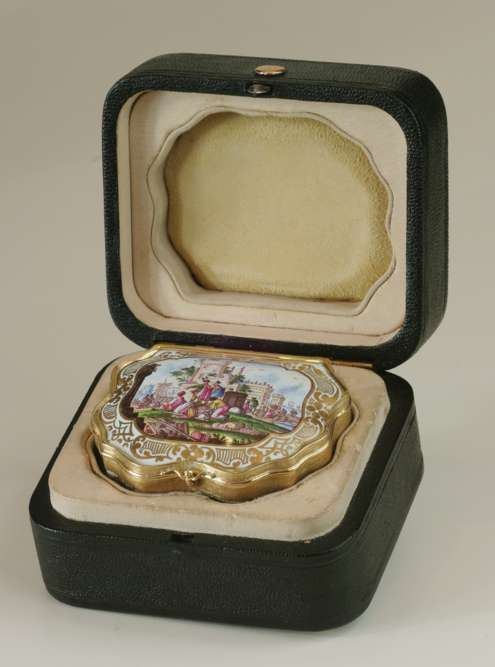
Finally, there is the case into which the box is perfectly fitted.
Obviously also of later date, but in and of itself a beautiful piece of
handiwork.
So,
that my friends is the extent of the mysteries I would
like some help resolving. The tabatiere was left to my mother and I by
my father, who passed away 20 years ago. He was a typical NY
antique dealer, constantly running from shop to shop all over New York
City. Where it was purchased, and for how much, I haven't a clue. Below
you will find thumbnails to all the views on each side of the box.
There is also a view of another example of Herold's work from Ms.
Menshausen-Handt's fine article. Each face is an artwork in its own
right. Please click on any of the photos on this page for a larger
view. If any one can shed some light on these puzzles, please email me
at:
designer(at)toast(dot)net. Perhaps someone with more
background and references can shed more light on this gem. Thank You. WK |
|
|
|
|
|
|